





Migrating Corsairs Legacy from Unity 2022 to Unity 6 by Tech-5 Team
Over the past months, one of the largest technical tasks inside Corsairs Legacy has been the migration from Unity 2022 to Unity 6.
From the outside, engine upgrades may sound like a relatively straightforward process - open project, update version, fix a few warnings, done. In reality, for a large open-world RPG with years of accumulated systems, custom rendering logic, streaming, AI, physics, and platform-specific optimizations, an engine migration becomes a major engineering project on its own.
For us, this transition affected nearly every core system in the game.
Why We Decided to Move to Unity 6
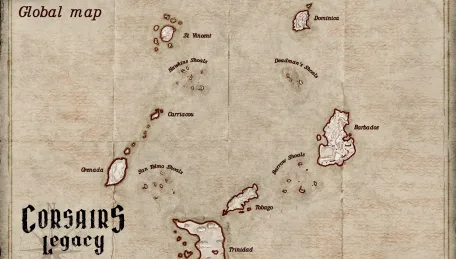
Corsairs Legacy is an unusually demanding project in terms of world scale and asset density.
The game contains:
- large seamless sailing areas
- dense tropical islands
- heavy vegetation usage
- large numbers of unique materials
- dynamic weather systems
- long-distance rendering
- ship interiors
- large quantities of 4K textures
- world streaming systems
- complex AI simulation
As development continued, memory management and streaming limitations inside Unity 2022 became increasingly noticeable - especially during long play sessions and while traversing large areas at sea.
One of the biggest pain points was texture streaming consistency.
In theory, texture streaming existed in previous Unity versions. In practice, under the scale and complexity of Corsairs Legacy, we regularly encountered situations where VRAM usage became unstable, textures loaded too aggressively, or streaming behavior simply did not react dynamically enough to changing gameplay situations.
This became particularly visible during sailing, where the player can rapidly move across huge environments with constantly changing visibility ranges.
The Migration Was Much Harder Than Expected
The transition itself was far from painless.
A large number of internal systems required refactoring or partial rewrites:
- rendering pipelines
- shader compatibility
- post-processing
- terrain systems
- vegetation rendering
- memory management logic
- streaming systems
- editor tooling
- custom plugins
- UI behavior
- third-party integrations
Some systems behaved differently even when the code itself remained unchanged.
In several cases, bugs only appeared after hours of gameplay or under very specific world streaming conditions. We also had situations where systems worked perfectly in editor builds but behaved differently in standalone builds after the migration.
Open-world projects are especially sensitive to these types of engine-level changes because many systems interact with each other continuously in real time.
The Biggest Improvement: Texture Streaming Finally Started Working Properly
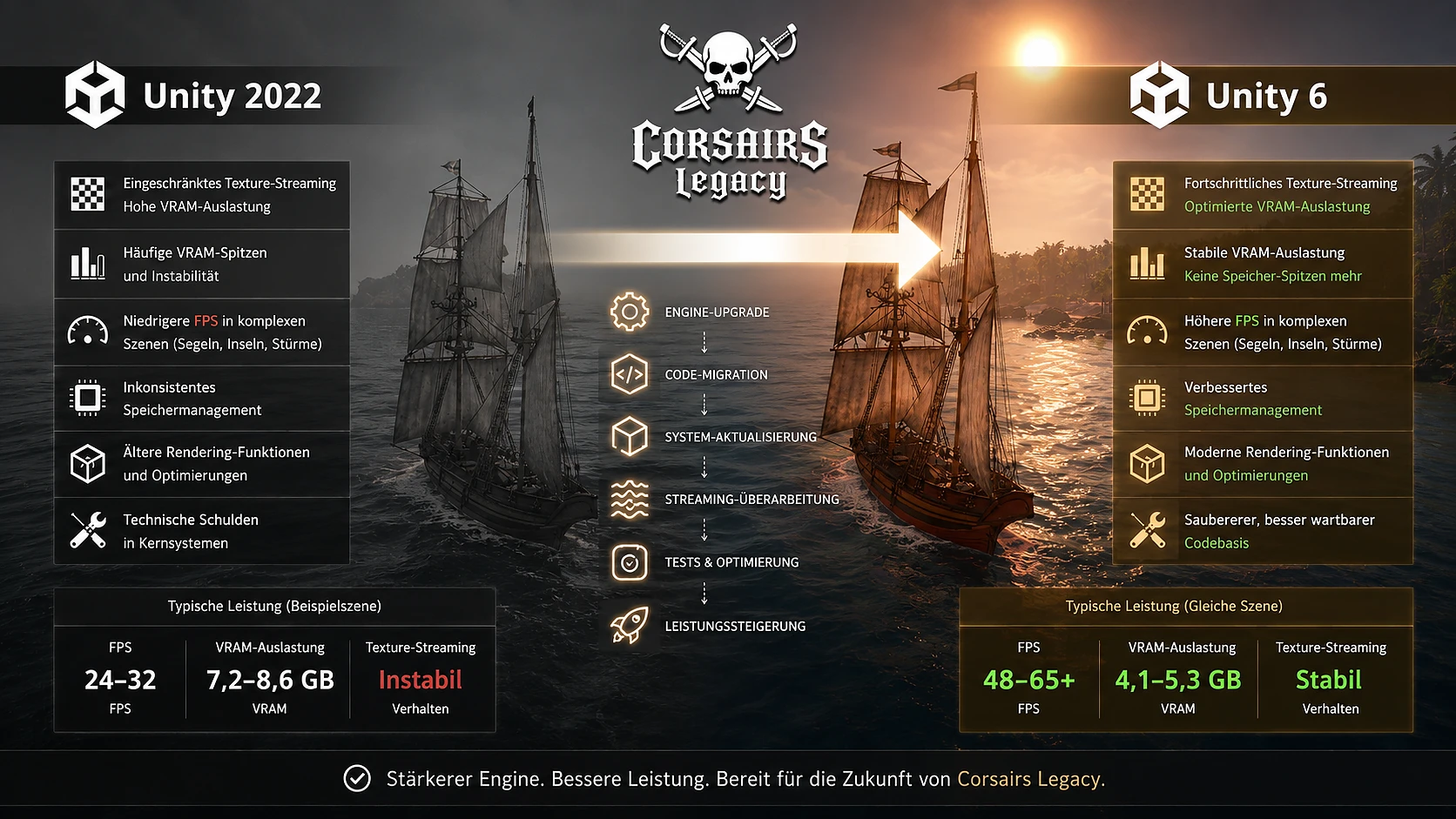
One of the most important technical improvements for Corsairs Legacy after moving to Unity 6 was the dramatic improvement in texture streaming behavior.
This has been a massive change for us.
Because Corsairs Legacy heavily relies on high-detail environments and large amounts of 4K textures, VRAM pressure has always been one of the key technical bottlenecks - especially on mid-range GPUs and handheld systems.
With Unity 6, streaming behavior became significantly more stable and predictable.
The engine now does a much better job dynamically managing texture residency depending on:
- camera visibility
- distance
- scene importance
- movement speed
- active memory pressure
This allowed us to substantially reduce unnecessary VRAM load while keeping image quality high where it actually matters.
In practice, this means:
- fewer sudden VRAM spikes
- better memory stability during long sessions
- smoother traversal while sailing
- fewer aggressive texture unload/reload situations
- improved scalability across different hardware tiers
For a game like Corsairs Legacy, where the player can stand on a ship and simultaneously observe:
- ocean surfaces
- islands
- vegetation
- settlements
- ships
- distant terrain
- dynamic weather
- volumetric effects
...this improvement became extremely important.
FPS Improvements
Another major result of the migration has been performance gains.
After months of optimization work on top of the Unity 6 migration, we started seeing substantial FPS improvements in several heavy gameplay scenarios.
This was especially noticeable during:
- large-scale sailing
- island traversal
- dense vegetation areas
- weather-heavy scenes
- long-distance rendering situations
Part of these gains comes from Unity 6 itself, while another part comes from the fact that the migration forced us to revisit and optimize several older systems that had accumulated technical debt over the years.
In some ways, the migration acted as a large-scale “technical cleanup” phase for the project.
Still Work in Progress
Even though the migration is already bringing visible benefits, this process is still ongoing.
Engine migrations for large games are never truly “finished” immediately after the first successful build. There are always edge cases, platform-specific behaviors, and optimization opportunities that only become visible during extended testing.
We are continuing to improve:
- memory behavior
- streaming logic
- controller/platform compatibility
- CPU bottlenecks
- GPU-heavy rendering paths
- Steam Deck performance
- shader optimization
- loading stability
But overall, moving to Unity 6 has already become one of the most impactful technical upgrades in the development of Corsairs Legacy so far.
And most importantly - it gives us a much stronger technical foundation for the future of the project.
22.08.2025, Tech-5 Team

A new pirate game is now on Steam
Buy on



 BuySteam key18$25$
The game is already available on Steam