





Cuba Island Map. Sea Dogs: To Each His Own — Trade and Secrets
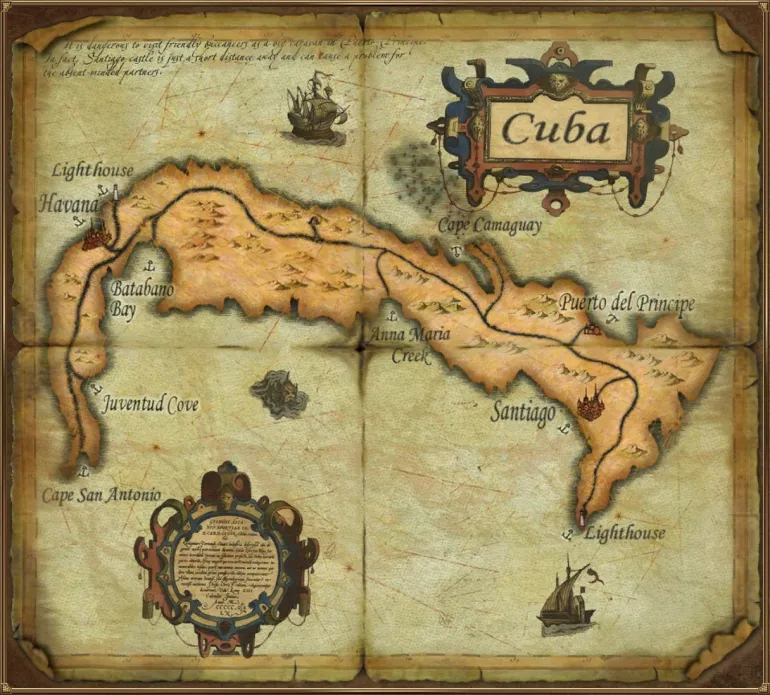
Sea Dogs: To Each His Own — Cuba island map
Cuba is an almost entirely Spanish-populated island in Sea Dogs: To Each His Own. It includes three towns at once: the colony of Havana in the west, Santiago in the east, and the pirate settlement of Puerto Principe on the island’s north-eastern edge.
You will visit Cuba repeatedly during the main story quests in Sea Dogs: To Each His Own. Moreover, this is where the storyline involving the Jade Skull continues — if you chose to sell it during the “Dutch Gambit” questline.
In fact, that’s the only practical choice: if you keep the skull, you won’t get any real benefit from it.
The Havana shipyard is one of the few in the Caribbean where you can upgrade your ship’s stats in Sea Dogs: To Each His Own. Here, just like in Porto Bello, you can increase either deadweight or the ship’s maximum cannon capacity. For deadweight you’ll need lignum vitae; for cannons you’ll need resin. Payment, of course, is in doubloons.
Unfortunately, Havana is short on street vendors. There are only two: a hardware dealer and a herb woman. That’s the worst result in the entire archipelago, on par with Blueweld. But sea trade is a completely different story.
Below is a table with shop prices that differ from the standard values. The first thing you’ll notice is the presence of scarce (“orange”) goods — items you can sell in town for an excellent profit.
What’s more, “green” bargain prices in Havana apply not only to gold and silver, but also to coffee, which is a scarce commodity in some other cities.
Goods in Havana in Sea Dogs: To Each His Own
For many veteran Sea Dogs players, the first association with the Spanish city of Santiago is the Inquisition headquarters — and yes, you will have to deal with the Inquisition during the Sea Dogs: To Each His Own storyline.
In Santiago, unlike Havana, you’ll find an almost complete set of street vendors — the only one missing is the native trader (apparently, selling animal fangs and similar curios under the Inquisition’s nose is not the best idea).
As for sea trade, it is fully identical to the neighboring pirate settlement, Puerto Principe. Unfortunately, Puerto Principe itself is not particularly special — it’s a standard pirate town with only a shop, a tavern, and a residence.
Now let’s move on to the price table that differs from the standard values. Essentially, the main highlight here is the “green” price on leather — in some cities it’s a scarce commodity.
Goods in Santiago and Puerto Principe in Sea Dogs: To Each His Own
The price tables are relevant for Sea Dogs: To Each His Own version 1.7.3.
Good news for manga rosa hunters (a valuable herb used to brew the best potions in the game, including those that grant permanent stat bonuses): you can find two manga rosa plants on Cuba.
For both plants, head to Cape Camaguey: the first manga rosa is by a broken tree near the water, and the second manga rosa is in the center of the next area, between the trees.
Reminder: in Sea Dogs: To Each His Own, you can pick up manga rosa only on your first visit to the location in a playthrough — after you leave the area, the manga rosa disappears.
If you need the complete archipelago map, we recommend reading this guide.
We hope this material was useful to you!
This article was prepared during the development of the pirate life simulator Corsairs Legacy to promote naval themes in general and pirate games in particular.
You can follow project news on our website, as well as on our YouTube channel and on Telegram.
Learn more about our project and add it to your wishlist on the Steam page.
Jamaica map | Isla Tesoro map | Turks map | Tortuga map | Cayman map | Hispaniola map | Puerto Rico map | Saint Martin map | Saint Christopher map | Antigua map | Guadeloupe map | Dominica map | Martinique map | Barbados map | Curaçao map | Trinidad and Tobago map | Cumana map | Caracas map | Maracaibo and Cartagena map | Portobello and Panama map | Blueweld map | Belize map | Sea Dogs: To Each His Own — Archipelago map

A new pirate game is now on Steam
Buy on








 BuySteam key18$25$
The game is already available on Steam